Complementary colors: build contrast without visual noise
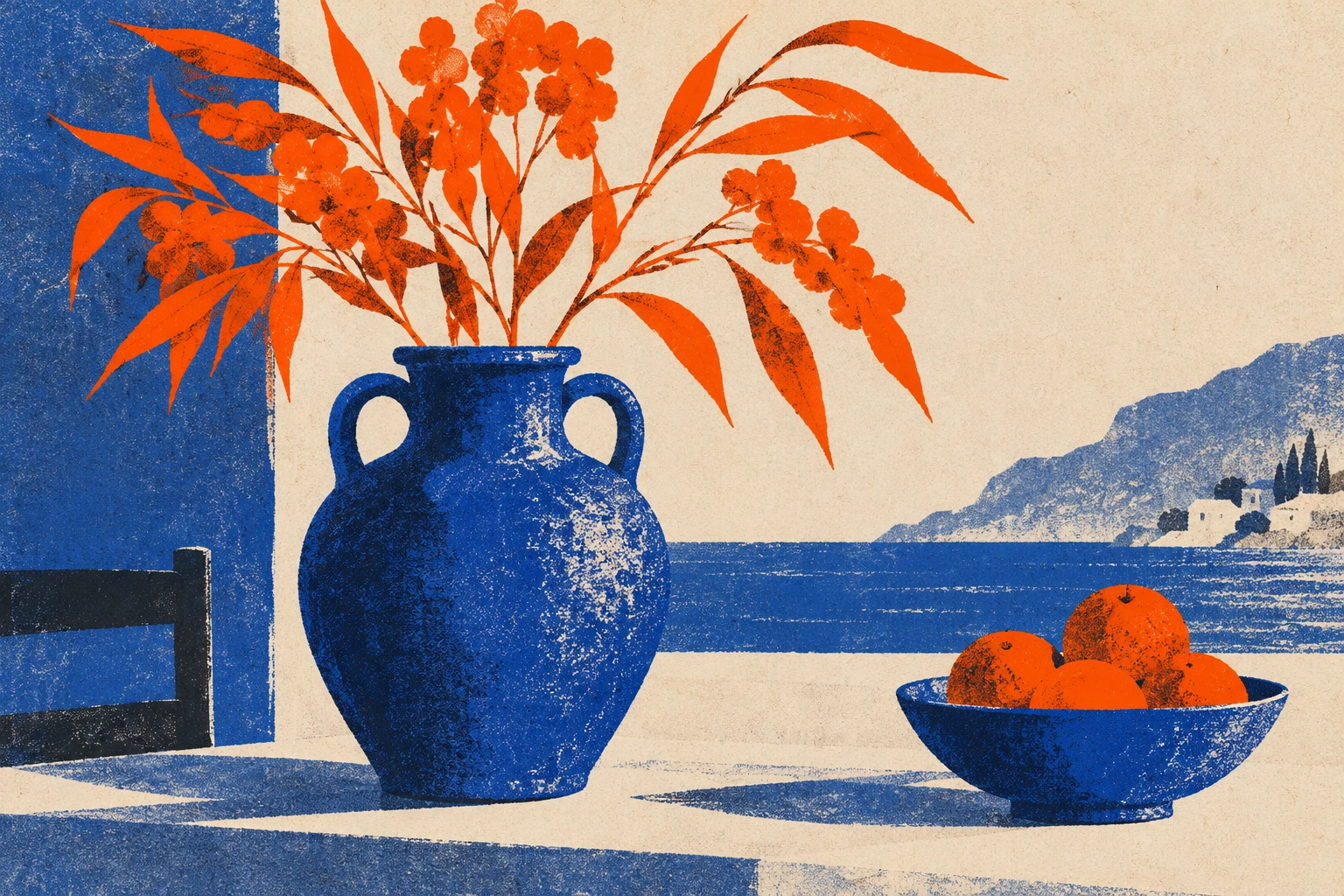
Use opposing hues with controlled area and lightness, then troubleshoot vibrating edges and competing accents in a practical two-color composition.
Follow a topic, look up a technique, or find an idea to try.
Use opposing hues with controlled area and lightness, then troubleshoot vibrating edges and competing accents in a practical two-color composition.
Develop a simple original logo concept, test its silhouette and small-size behavior, and prepare useful variations without relying on effects to create recognition.
Choose a primary text family, add a contrasting partner only where needed, and coordinate apparent size, weight, rhythm, and hierarchy across the page.
Use slow edge observation, selective interior lines, and occasional blind studies to improve attention and proportion while keeping the drawing connected to the actual subject.
Draw a useful user flow for submitting artwork by separating actions, decisions, system responses, and recovery routes instead of documenting only the successful path.
Investigate a studio-equipment booking idea by separating observed problems, assumptions, operational limits, and solution options before deciding what deserves a prototype or further research.
Walk through a reference-board task using keyboard input, recording reachability, operation, visible focus, order, and escape routes while distinguishing a useful check from a complete accessibility evaluation.
Create and operate a paper booking prototype with state cards, realistic content, a facilitator script, and interruption cases, then record questions without treating the exercise as evidence of implementation behavior.
Construct a small vector field for wandering lines, then diagnose tangles by separating field scale, movement distance, and the number of drawing agents.
Design the pace of a movement by comparing linear travel, gradual starts, and gradual stops, then choose an easing curve according to the action's intent.
Plan a modest room-scale artwork around a clear encounter, a limited active area, and a response that remains understandable when several people approach the piece.
Connect rigid card strips with simple pivots to make a controlled gesture, then adjust joint spacing and movement limits before attaching a lightweight sculptural form.
Create a coherent palette from neighboring hues while preserving depth, legibility, and a useful focal point through lightness, intensity, and spacing.
Plan a poster around its first message, viewing distance, and essential details, then use scale and spacing to make the reading order clear.
Build a restrained system of headings, paragraphs, captions, and labels, then use spacing and repeated roles to make a document easier to scan and read.
Look for the main movement, weight, and connected masses in a pose, then use short studies to avoid stiff outlines and disconnected body parts.
Use a saved-work collection to plan a small interaction from trigger to feedback, including pending, failed, repeated, and undone actions without misleading animation.
Turn a broad request to improve an art-school resource library into a focused statement of people, circumstances, obstacles, consequences, and unanswered questions without prescribing a solution.
Plan a visible keyboard focus treatment across buttons, links, image cards, overlays, and sticky regions, then check its continuity through a realistic task instead of relying on a component sample.
Build a paper-prototype kit with screen frames, state labels, reusable controls, content cards, and a response map while avoiding a template that silently dictates the design.
Compare independent variation with neighboring variation in a controlled line study, and choose a generator according to the kind of visual relationship your artwork needs.
Construct a repeating movement whose boundary is intentional, checking both position and direction so the join feels continuous when the sequence begins again.
Create a browser drawing experiment in which speed or direction changes the mark, while separating input tracking from the visual rule so the gesture remains readable.
Design a sliding paper reveal with a clear grip, enough clearance, and a stopping point, turning a single motion into a small sequential scene.