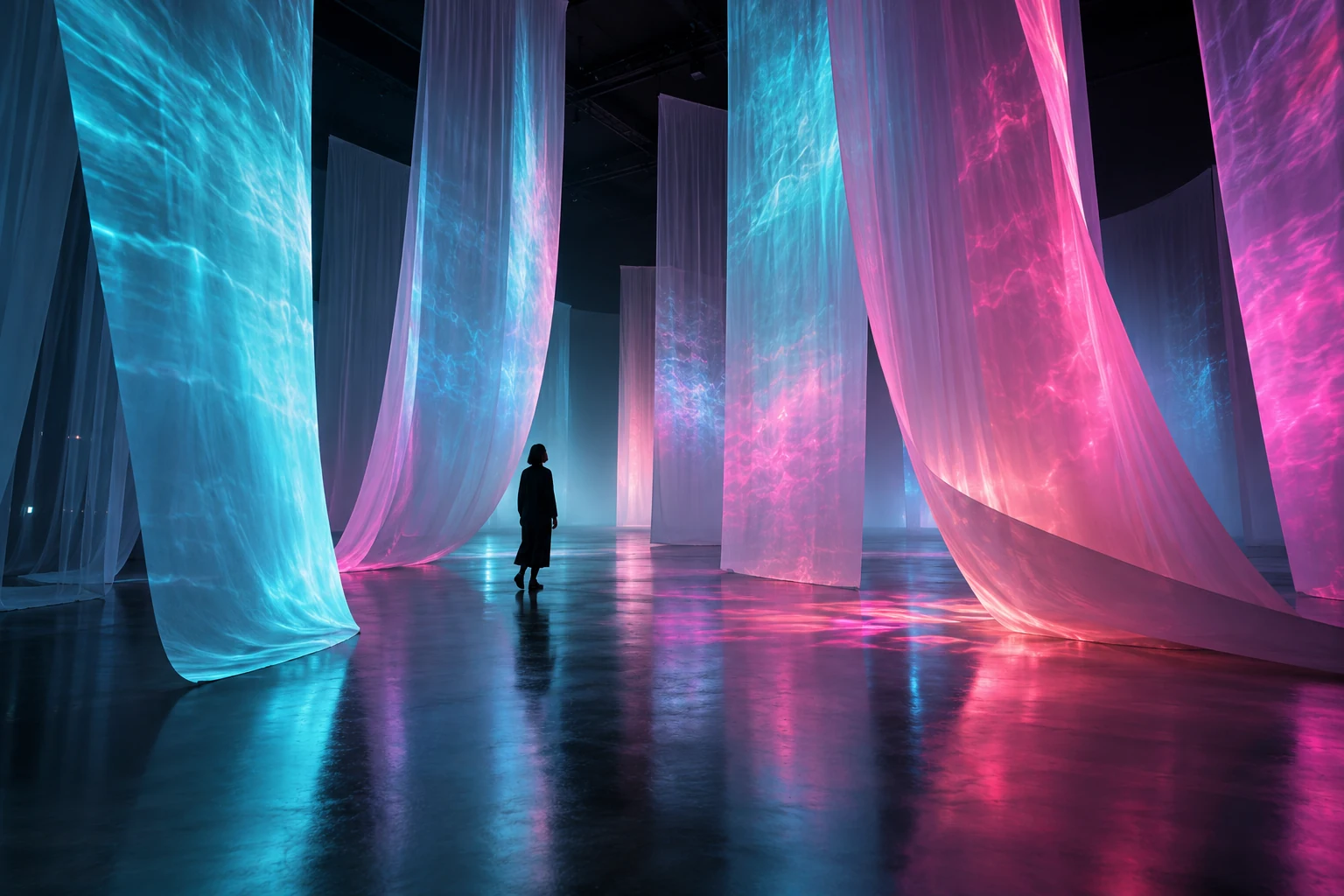
Interactive installation ideas for a small room
Plan a modest room-scale artwork around a clear encounter, a limited active area, and a response that remains understandable when several people approach the piece.

The first encounter happens in space
An interactive installation starts with an encounter in space. A visitor sees something, approaches it, tries an action, and observes a response. In a small room, one well-defined exchange can be more compelling than several competing stations. Design the scene around what the visitor notices first.
Mark the active area at its actual height
Mark the active area on the floor with removable tape and stand in the visitor's likely entry position. Mock up the object and response at their actual heights. Use a simple manual trigger before installing sensors so you can test the spatial relationship independently.
The useful adjustable quantity in this study is active area size; give it a name and a clearly recorded starting value. Work from a rough thumbnail or a small physical mockup. Mark the feature that must remain stable and the feature that is allowed to change. Those marks provide a reference when several plausible variations begin competing for attention. A useful acceptance check is whether the response remains visible from the participant and observer positions. Judge that at the intended viewing size or working distance, where tiny construction mistakes and exaggerated effects can have very different consequences.
Keep the participant from hiding the response
If people approach from the wrong side, inspect the visible invitation and the room's natural circulation. If the response is hidden by the participant's body, move the output or change the viewing angle. These are spatial problems that a more elaborate program may not solve.
Use the plain reference to decide whether active area size caused the problem or merely made it easier to notice. Try an ordinary action, an incomplete action, and two actions in quick succession. Watch whether the piece acknowledges each input and returns to a usable state afterward.
Test solo, observed, and shared encounters
Try the encounter alone, with a companion watching, and with two people acting together. Sketch where each person stands and what they can see. Look for a version where participation and observation both have a useful place.
Build a comparison around these settings: a tabletop zone, a one-person floor zone, and a shared zone. Use the first trial as an anchor, the second as a moderate departure, and the third to reveal the limit of the idea. Return to the anchor before deciding. The final choice may sit between the tested values; use the comparison to identify that smaller next adjustment.
Test the work from the doorway
Place a chair or cardboard stand-in where the installation will be and inspect it from the room's entry. A visitor should be able to notice a plausible action before understanding every detail. Then stand where a companion would watch. For the translucent houses, check whether the participant's arm blocks the changing windows. Moving the light's handle to one side may improve the encounter more than making the windows brighter.
Translucent houses and a shared light
Create a table of translucent paper houses whose windows change when a visitor moves a shared light source. The effect can begin as a hand-operated lamp study. The installation's interest comes from navigating relationships among light, shadow, and other viewers.
References & further reading
Examples and exercises in this guide are original teaching scenarios.