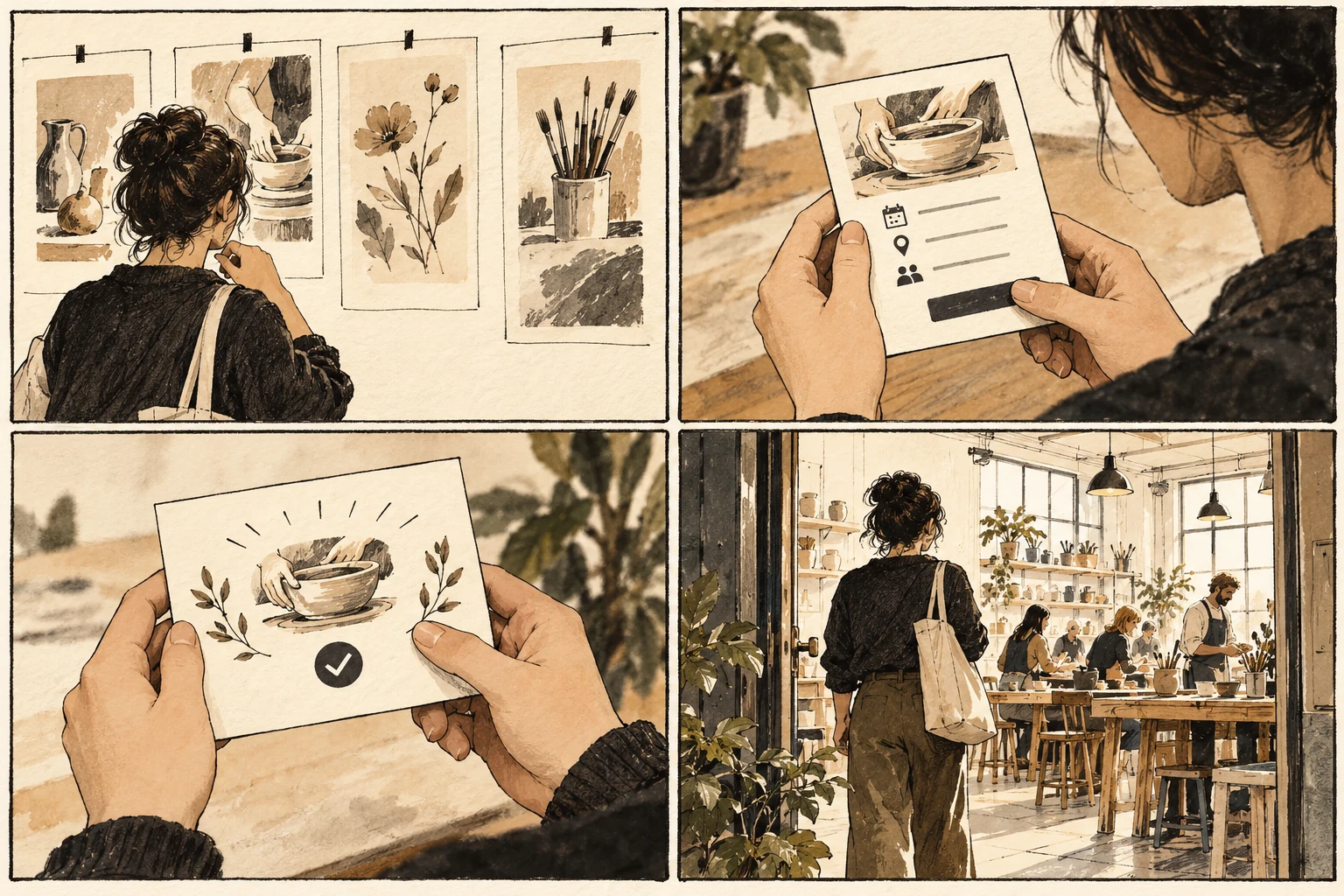
Interaction design examples: make a workshop booking understandable
A booking journey makes interaction design tangible: choices, system states, feedback, and recovery all become visible in a small, testable sequence.

A booking journey makes interaction design tangible: choices, system states, feedback, and recovery all become visible in a small, testable sequence.
Distinguish interface behavior from the wider experience by tracing a gallery visit across booking, arrival, attendance, and follow-up without turning job titles into rigid boundaries.
Draw a useful user flow for submitting artwork by separating actions, decisions, system responses, and recovery routes instead of documenting only the successful path.
Use a saved-work collection to plan a small interaction from trigger to feedback, including pending, failed, repeated, and undone actions without misleading animation.
Choose a modal only for a bounded interruption, then plan its content, focus, dismissal, and recovery using a destructive project action as a worked example.
Compare accordions and tabs for a workshop guide, using visibility, comparison, headings, deep links, and keyboard behavior as practical decision criteria.
Plan validation timing, local error messages, an error summary, preserved answers, and system failures for an artwork submission form with realistic correction tasks.
Distinguish a new collection, a filtered collection, and a loading failure, then write useful next actions that match each state without inventing content.
Choose truthful loading feedback for an image collection, including initial load, incremental updates, slow responses, failures, and safe retry behavior without fabricated progress.
Organize an arts publication with clear destinations, stable labels, local navigation, and preserved context, then test the structure through realistic finding tasks.
Build a faceted reference search with clear selection logic, visible active filters, result updates, no-results recovery, and links that preserve a reader's chosen context.
Use deleting a reference as an example to distinguish immediate undo, recoverable trash, permanent deletion, time limits, and confirmation choices without making false recovery promises.
Plan reordering for a creative board with move controls, position feedback, cancellation, and narrow-screen behavior so that dragging is one useful route through the task.
Design a workshop confirmation around status, a usable reference, attendance details, next steps, corrections, and uncertain outcomes instead of a decorative success message alone.
Apply progressive disclosure to workshop booking by separating essential terms, optional detail, conditional questions, and advanced controls while keeping consequential information available before commitment.
Choose collection browsing behavior from the need to resume, compare, share, reach the footer, and preserve position, then prototype the return journey as carefully as discovery.
Create onboarding for a creative reference tool by finding its first useful action, delaying optional setup, explaining permissions, and supporting a clear return to unfinished work.
Use an exhibition audio-guide task to connect goals, actions, system states, feedback, and context, then turn a simple interaction model into a practical prototype.