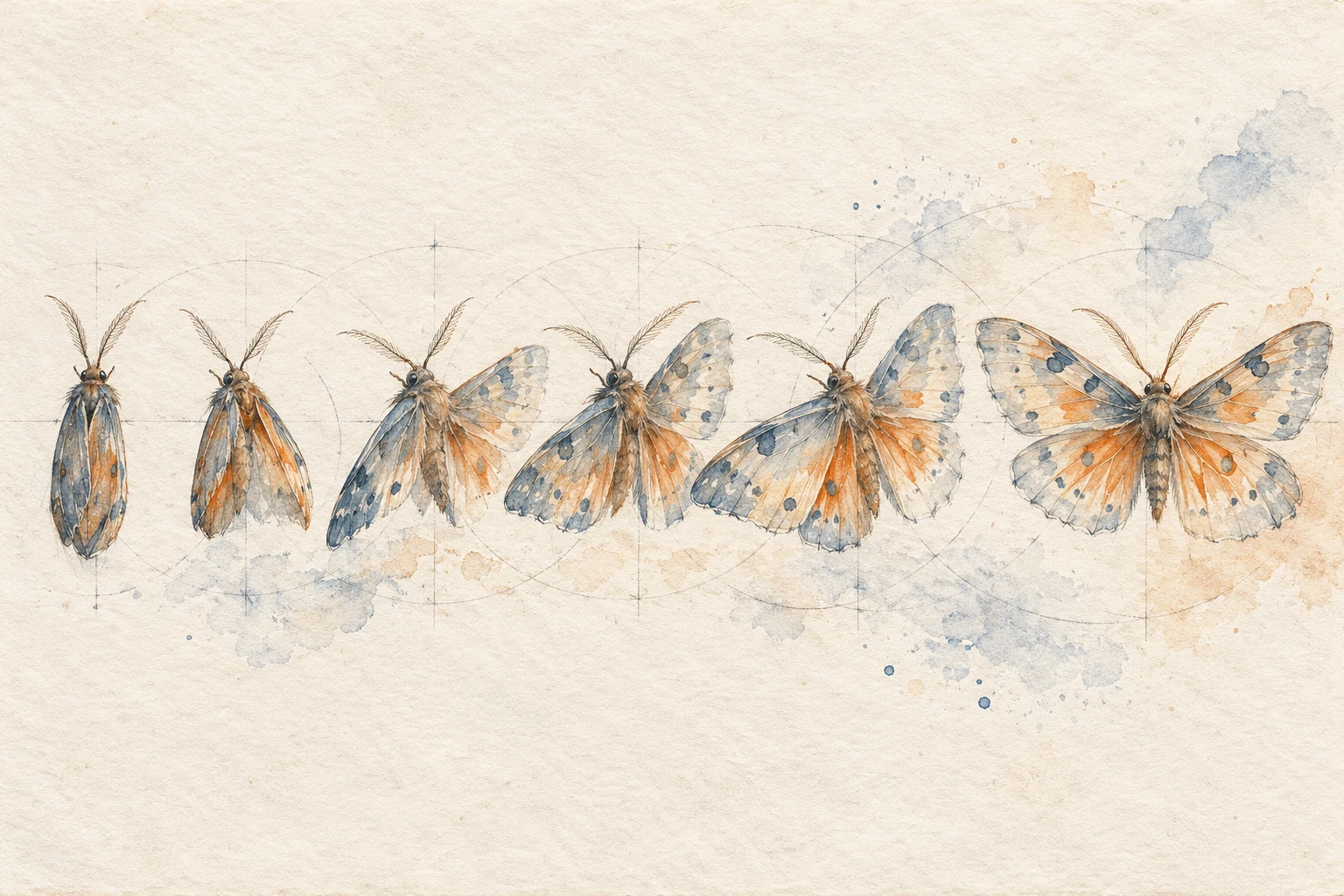
Make a seamless animation loop
Construct a repeating movement whose boundary is intentional, checking both position and direction so the join feels continuous when the sequence begins again.

The join is another moment of the action
A loop has two important boundaries: the last visible moment and the next first moment. Matching positions can conceal a spatial jump while leaving an abrupt change in direction. Think about what the object is doing through the join, not only where it happens to be.
Drive circular travel with a repeating phase
Choose a periodic movement such as a point traveling around a circle. Calculate its position from a phase that returns to the same cycle after one revolution. Render the cycle without appending an extra duplicate endpoint frame. Preview several repeats before adding secondary details.
Separate loop duration from the other decisions so that a later revision has an identifiable cause. Create a plain reference version before adding expressive variation. Preserve that reference while revising, because memory is poor at comparing subtle differences across separate sessions. Compare the versions in the same viewing conditions. A useful acceptance check is whether the boundary is hard to locate during ordinary playback. Judge that at the intended viewing size or working distance, where tiny construction mistakes and exaggerated effects can have very different consequences.
Inspect duplicate frames at the join
A tiny pause at the join may come from showing the same boundary position twice. A snap may come from resetting a value that never reaches the next cycle smoothly. Compare the final few positions with the first few as one continuous strip.
Treat a disappointing result as evidence about loop duration, rather than immediately adding another effect. Review the movement as a strip of still moments as well as in playback. Inspect the pose immediately before and after a confusing event.
Compare reversal with continuous orbit
Try a pendulum loop and a circular orbit using the same duration. Notice that the pendulum reverses direction at its extremes while the orbit keeps moving. Their joins need different kinds of evidence.
Use 1, 2, and 4 seconds as three deliberately separated trial conditions. Keep the subject, framing, and main materials consistent across those trials. Note what changes first, what remains stable, and where the intended effect becomes excessive. Choose a version for an articulated reason. A useful note names a visible relationship that you could inspect again, rather than simply calling the result better.
Check secondary parts at the boundary
A main object can loop perfectly while a shadow, petal, or trailing detail snaps back to its start. Inspect every animated property at the join, including opacity and any generated decoration. For the three-petal study, derive all phases from the same repeating cycle and fixed offsets. Avoid choosing new random details at the boundary unless the discontinuity is an intended event that the artwork visibly acknowledges.
Three phase-shifted petals
Animate three petals opening and closing around a fixed center. Offset their phases so they do not reach maximum size together. Use a single shared cycle length, making the repeated sequence feel coordinated even while the individual petals breathe at different moments.
References & further reading
Examples and exercises in this guide are original teaching scenarios.