Visual balance: arrange unequal shapes with purpose
Compare symmetry and asymmetry, judge the apparent weight of shapes, and balance a composition without making every side mechanically identical.
Follow a topic, look up a technique, or find an idea to try.
Compare symmetry and asymmetry, judge the apparent weight of shapes, and balance a composition without making every side mechanically identical.
Calculate effective image resolution from pixel dimensions and reproduction size, distinguish it from printer dot resolution, and avoid misleading metadata-only fixes.
Compare alignment methods using actual prose, inspect uneven word spacing and rag shapes, and select a treatment that supports the document’s reading task.
Simplify a hand pose into connected forms, compare finger groups and visible joints, and use overlap and empty shapes to avoid stiff, equally spaced fingers.
Plan reordering for a creative board with move controls, position feedback, cancellation, and narrow-screen behavior so that dragging is one useful route through the task.
Map a materials marketplace across listing, discovery, agreement, fulfillment, disputes, and status changes so buyer and seller needs remain connected throughout the exchange.
Review a creative-service sign-in flow for password-manager support, paste, code entry, clear recovery, and usable alternatives while coordinating requirements with the team responsible for account security.
Focus critique on a design question, task, constraints, and evidence, then separate observations, risks, suggestions, and decisions so feedback can guide revision without becoming a vote on taste.
Grow a field of nonoverlapping circles with explicit boundary checks and a stopping budget, then use the gaps as an active part of the artwork.
Create a modest sense of depth by moving layered scenery at different rates, checking the frame edges and preserving a coherent relationship between the layers.
Develop a short performance system in which repeated gestures alter a visual response, keeping the audience able to perceive the relationship between movement and change.
Combine clean everyday objects into a small sculptural arrangement, choosing a shared formal relationship and reversible connections before committing to a final assembly.
Direct attention with a coordinated choice of contrast, scale, placement, and detail, then reduce competing signals without flattening the rest of the image.
Understand display and print color as different reproduction systems, use the right output guidance, and proof important colors instead of expecting identical appearances everywhere.
Organize paragraphs with clear separation, deliberate first-line indents, and stable styles, while keeping quotations, lists, and headings connected to the surrounding prose.
Observe the overall crown, trunk direction, branch groups, and light-dark masses, then suggest foliage with selective marks appropriate to the tree’s distance and character.
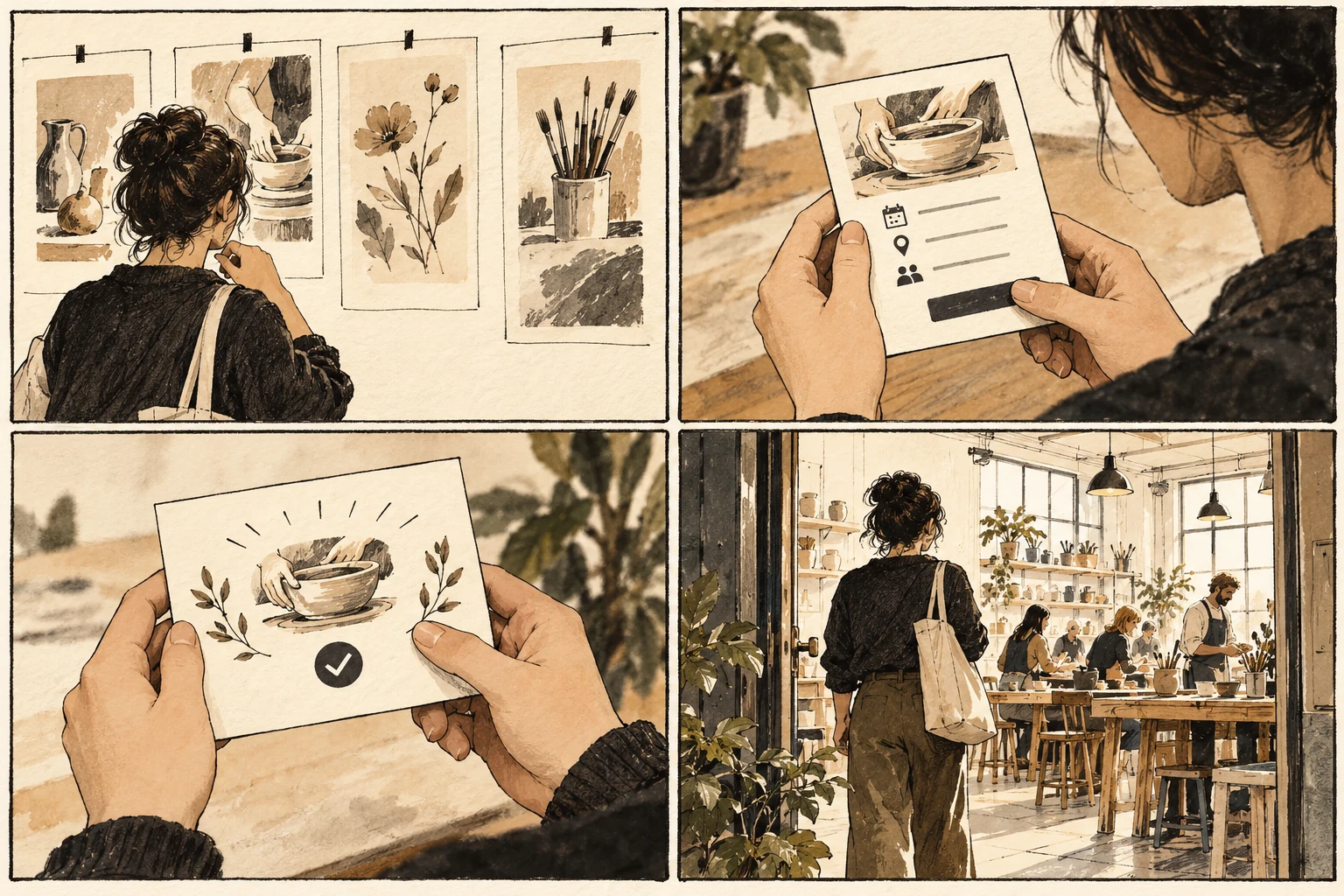
Design a workshop confirmation around status, a usable reference, attendance details, next steps, corrections, and uncertain outcomes instead of a decorative success message alone.
Plan a creative-resource subscription through plan information, renewal, status, cancellation, and access changes, with clear consequences and operational rules rather than promotional ambiguity.
Improve links in an arts reading list by naming their purpose, preserving useful context, distinguishing files and actions, and checking repeated labels without relying on surrounding visual layout alone.
Prepare a workshop-booking handoff with states, content, rules, responsive behavior, accessibility considerations, dependencies, and open questions so implementation does not depend on guessing from polished screens.
Create a texture from a modest vocabulary of marks, using density and orientation as separate controls and preserving enough structure for the material to read clearly.
Transform one drawn shape into another by pairing corresponding points and inspecting intermediate silhouettes, with a method for avoiding tangled or collapsing geometry.
Explore projection with a small white paper form, aligning a few graphic shapes to its surfaces and testing how viewpoint and ambient light affect the result.
Compare simple connections for small art objects, selecting a joint according to whether the parts need to rotate, stay rigid, or come apart for revision.