Negative space in art: draw the gaps to improve the whole
Use the shapes around and between objects to improve placement, proportions, grouping, and breathing room in drawings, posters, and small compositions.
Follow a topic, look up a technique, or find an idea to try.
Use the shapes around and between objects to improve placement, proportions, grouping, and breathing room in drawings, posters, and small compositions.
Understand how shape-based and pixel-based images behave, choose a sensible master format, and avoid common export and enlargement mistakes in mixed design projects.
Learn useful terms for letter structure, then use counters, x-height, stroke contrast, terminals, and spacing to compare typefaces with real content.
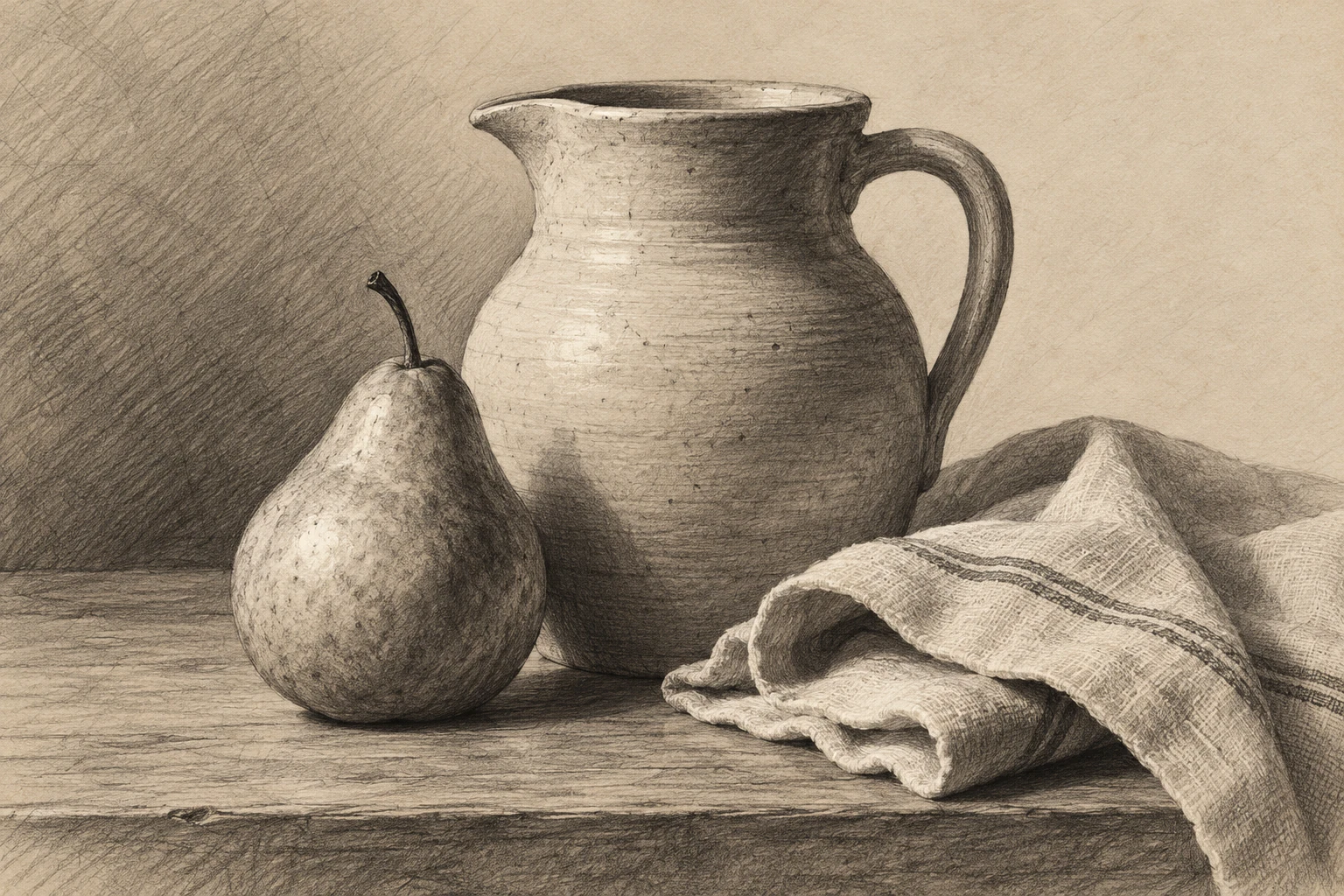
Set up a small group with clear overlaps and light, plan the large composition, and develop a still life without losing the relationship among its objects.
Build a faceted reference search with clear selection logic, visible active filters, result updates, no-results recovery, and links that preserve a reader's chosen context.
Map a booking across visitor actions, visible communication, staff work, systems, and handoffs to find responsibilities and recovery gaps that a screen-by-screen journey may miss.
Organize an exhibition guide with meaningful headings and programmatic relationships so its outline supports scanning and navigation while visual styling remains free to express the publication's character.
Organize research observations into meaningful groups while preserving context, source references, counterexamples, and the distinction between observation and interpretation in a studio-service analysis exercise.
Construct spirals from radius and angle, then use turn spacing and sampling to choose between a precise coil, a loose sweep, and a densely wound form.
Block a repeating walk through contact, passing, and weight shifts, using a small character whose feet and body can be checked independently.
Design a shared drawing system with a clear contribution rule, making individual actions visible while allowing their accumulation to become a larger collective form.
Make an expressive fabric object from a small pattern, using seam placement, stuffing distribution, and a restrained silhouette to establish its character before adding details.
Use a thirds grid to explore placement, horizons, and directional space, then judge the actual shapes instead of forcing every subject onto an intersection.
Compare practical uses of JPEG, PNG, SVG, and PDF, preserve an editable master, and test exports for transparency, sharpness, and production suitability.
Create a small set of coordinated sizes, use ratios as an optional starting point, and adjust the system around real headings, paragraphs, and constrained layouts.
Observe a particular head rather than a generic face formula, locate the major feature relationships, and use restrained value shapes to build a coherent portrait study.
Use deleting a reference as an example to distinguish immediate undo, recoverable trash, permanent deletion, time limits, and confirmation choices without making false recovery promises.
Set practical rules for proposing, reviewing, documenting, changing, and retiring shared interface patterns without letting a small design system become a barrier to useful product work.
Plan a skip-to-content route for an arts publication, including a meaningful target, visible focus, repeated navigation, sticky headers, and verification that keyboard movement continues in the intended place.
Map workshop attendance across preparation, booking, travel, participation, and follow-up while distinguishing evidence, assumptions, opportunities, and organizational responsibilities instead of decorating an invented story.
Design a small rule-based grid using explicit neighbor counts, then compare behaviors from the same starting pattern without confusing update order with emergent structure.
Build a short abstract sequence from a few geometric objects, choosing a leading action and arranging supporting movements into a clear visual phrase.
Make a playful artwork around exploration and consequence, using a clear action rule and a discoverable transformation instead of assuming that every game needs points.
Build a small sculptural form from interlocking card profiles, adjusting slot fit and grain direction before applying surface detail or extending the structure.