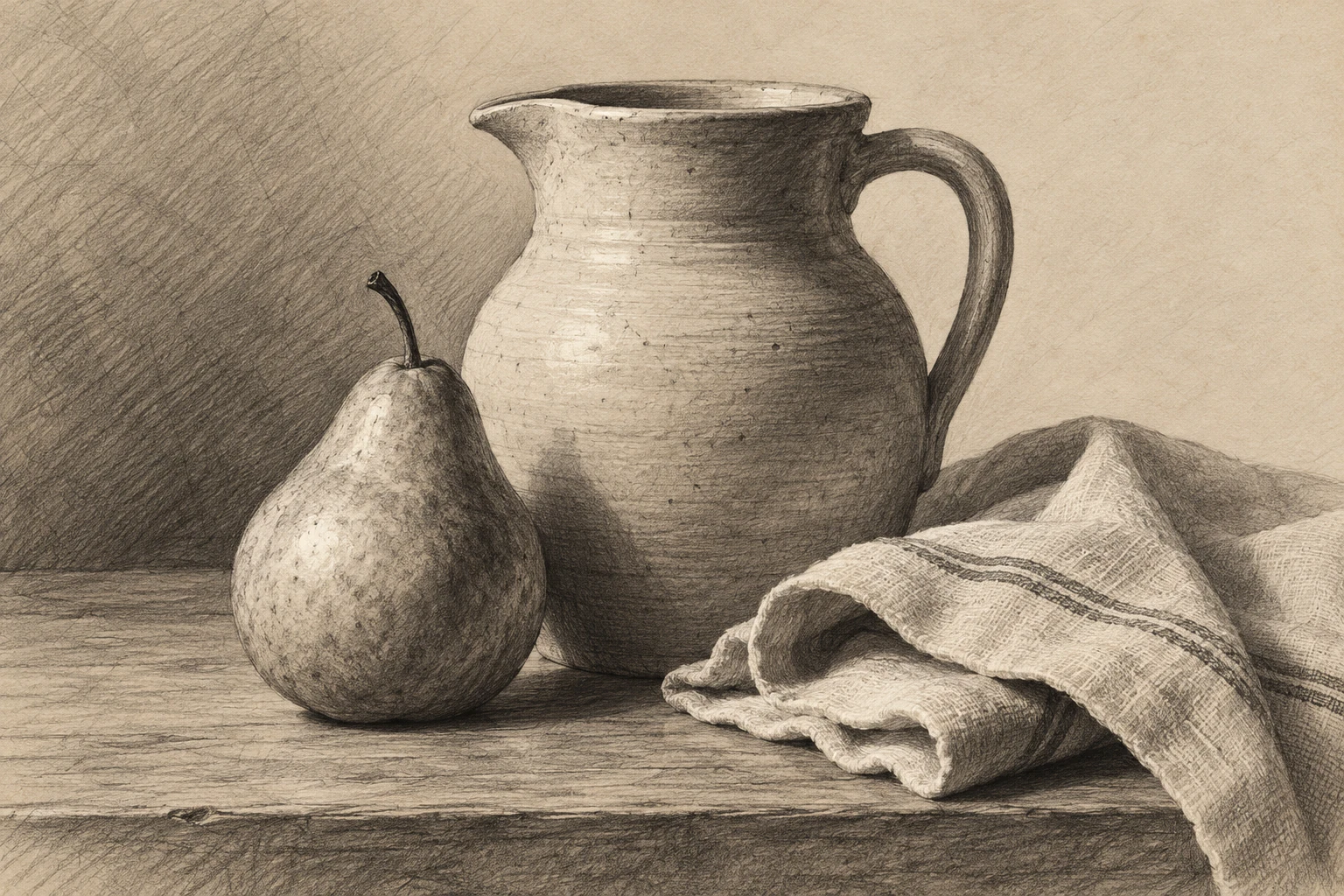
Drawing ideas that teach you something specific
Turn everyday subjects into purposeful drawing prompts, vary one challenge at a time, and build a small practice sequence that reveals what to study next.

Choose a question before a subject
A useful drawing prompt combines a subject with something to investigate. Draw a shoe is open-ended; draw a shoe using only three values asks a clear question about light and dark. The restriction helps you decide what to notice and how to assess the result afterward.
List a few available subjects rather than waiting for an inspiring one. A bag, a kitchen tool, a plant, a window, or your own hand can support many different studies. The interest comes from the visual problem you choose, not only from the novelty of the object.
Build prompts from visual variables
Change one variable at a time: viewpoint, scale, line quality, value range, time limit, or degree of simplification. Draw the same cup from above and below, or describe the same leaf with contour and then with flat shadow shapes. These comparisons reveal the effect of the method more clearly than unrelated subjects do.
Keep the challenge small enough to finish as a study. A complex city scene with dramatic lighting, crowds, and unfamiliar perspective can hide the issue you wanted to learn. Isolate one building corner or one group of figures first. You can combine the skills later when each part is more understandable.
Mix observation and invention
Observational prompts train you to compare what is visible. Invented prompts ask you to transform or combine that knowledge. Pair them: study a real folded cloth, then invent a cloak with a similar large fold pattern. Keep the invented version clearly separate from the observation so you can identify which decisions came from reference.
Use references you have permission to use, your own photographs, or direct observation. Do not trace someone else's finished illustration and present the result as an original study. Studying structure and then creating a new arrangement gives you a more useful understanding than copying a recognizable composition without analysis.
Review a small sequence
Keep a page of several studies together and write a brief note beside each. Describe a concrete observation: narrow gaps were hard to judge, or the three-value version read more clearly. Those notes help you choose the next prompt instead of repeating the same comfortable exercise indefinitely.
Alternate familiar subjects with a controlled new challenge. If every session introduces a completely different tool and subject, it becomes hard to see progress. If nothing changes, practice can become automatic. A small sequence with one deliberate variation gives you both continuity and a reason to pay attention.
Try it yourself
- Combine an ordinary subject with one visual question.
- Change a single variable across a short sequence.
- Write an observation that determines the next study.
Exercise: five studies of one paper bag
Use a plain paper bag for five prompts: draw only its outer contour; draw its shadow shapes in three values; draw it from above; simplify it into five large planes; and invent a tiny storefront using its folded structure. Keep each study modest. Afterward, compare where the bag's opening became unclear and which folds actually explained its form. Choose one issue for a sixth study. The sequence supplies several distinct drawing ideas while keeping the subject familiar enough for meaningful comparison.
References & further reading
- National Gallery of Art: Explore the Basics of Drawing ↗
- Harold Speed: The Practice and Science of Drawing (public-domain edition) ↗
Examples and exercises in this guide are original teaching scenarios.