Squash and stretch without accidental size changes
Use coordinated changes in height and width to express softness, impact, and recovery, while keeping the shape's apparent mass under deliberate control.

Material through changing proportions
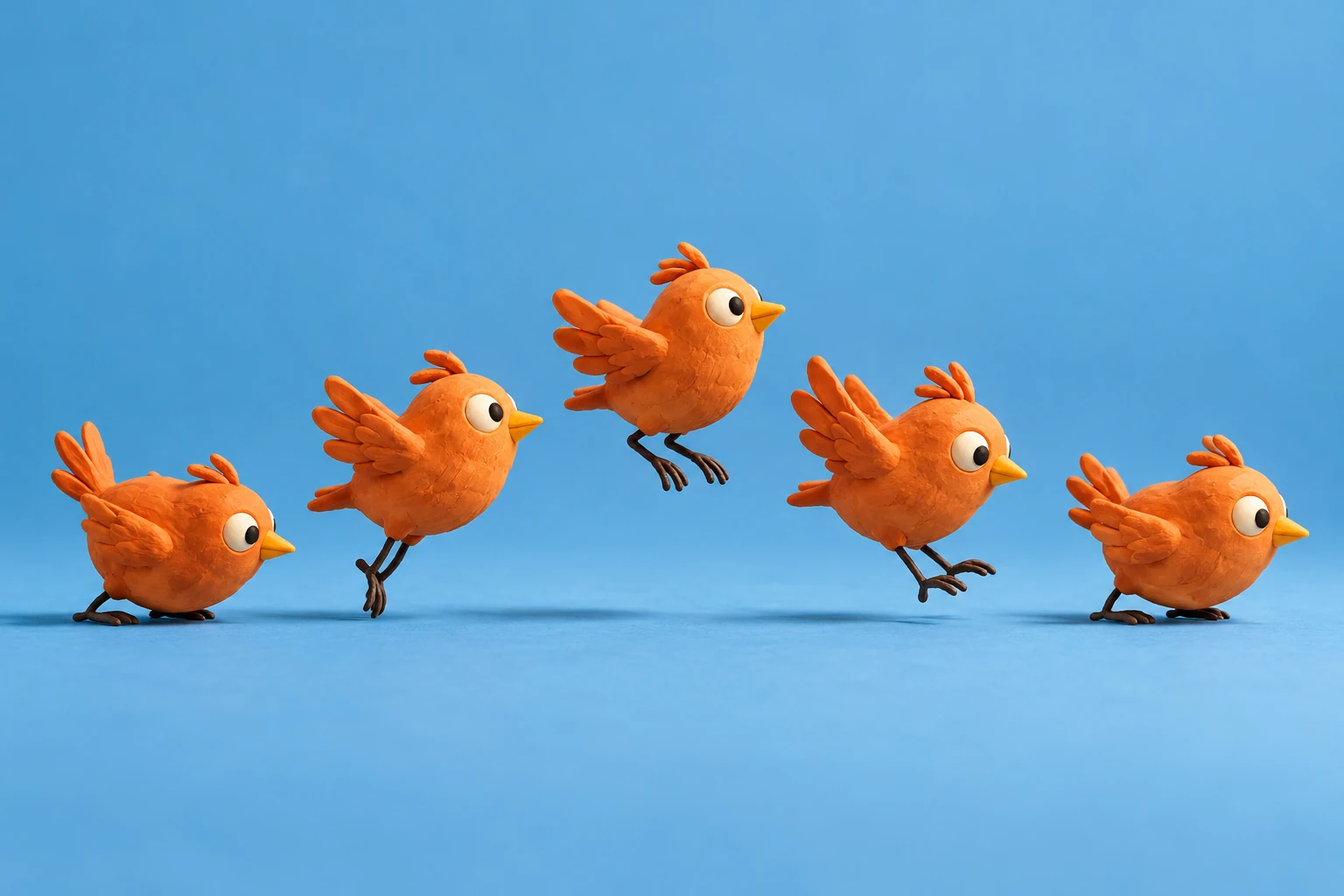
Squash and stretch make a simple shape behave as though it has a material. A soft bean can compress on impact and lengthen during a jump. The effect becomes distracting when the object also seems to gain and lose its substance without an expressive reason.
Coordinate width and height around contact
Begin with an ellipse and mark its ordinary width and height. Make a compressed pose wider as it becomes shorter. Make an elongated pose narrower as it becomes taller. Keep its contact point fixed during the squash so the deformation reads as pressure against a surface.
Set up the first proof around maximum compression, using a value you can recognize in the finished result. Break the construction into a single working unit and a repeated or extended form. Verify the unit on its own first. Only multiply it after its boundaries, movement, and proportions match the proposed rule. A useful acceptance check is whether the shape changes material expression while retaining a believable amount of substance. Judge that at the intended viewing size or working distance, where tiny construction mistakes and exaggerated effects can have very different consequences.
Find floating feet and accidental inflation
If the bean seems to float, inspect its lowest point during deformation. Scaling around the center can lift it away from the floor. If it feels like an inflating balloon, reduce the change in apparent area and separate stretching from simple enlargement.
Before rebuilding everything, compare the current maximum compression setting with the last understandable version. Review the movement as a strip of still moments as well as in playback. Inspect the pose immediately before and after a confusing event.
Give two landings different materials
Animate the same landing as a rubber ball and a doughy dumpling. Keep the falling path unchanged. Change the depth and duration of compression, then compare how quickly each version recovers.
Reserve one trial each for a subtle flattening, a moderate flattening, and a broad pancake. Place the results together, or replay them in a fixed order when movement matters. Look for the smallest change that alters the reading of the work. If every trial produces a different problem, reduce the distance between the settings and investigate the transition instead of choosing an extreme.
Anchor the contact point during scaling
For a bean resting on a floor, calculate its center height from the floor position and its current half-height. As the bean flattens, this keeps the lowest point on the same line. Scaling around an unchanged center would move that contact point. Show the floor and a temporary contact dot while testing. Only remove those guides after the compression reads as pressure against a surface throughout the pose change.
A bean preparing to jump
Create a tiny jumping bean that compresses before launch, stretches during upward travel, and returns to its ordinary shape near the top. Use only three deformation poses at first. Add intermediate shapes only when they clarify the timing between those states.
References & further reading
Examples and exercises in this guide are original teaching scenarios.