Cutout animation: place the joints before the details
Create an articulated paper or digital figure by locating pivots, allowing overlap at the joints, and blocking the movement before decorating the parts.

Rigid parts can make a clear gesture
A cutout figure is a collection of rigid parts that overlap and rotate. The placement of its pivots determines what gestures are possible. A beautifully decorated arm with a misplaced shoulder can be harder to animate than an undecorated rectangle whose joint works well.
Place pivots inside overlapping card parts
Cut a torso, upper arm, forearm, and hand from scrap paper. Add extra material at each joint so neighboring pieces remain overlapped while rotating. Try the main gesture on a flat surface before fastening anything. For digital cutouts, place each rotation origin at the equivalent joint.
The useful adjustable quantity in this study is joint overlap; give it a name and a clearly recorded starting value. Create a plain reference version before adding expressive variation. Preserve that reference while revising, because memory is poor at comparing subtle differences across separate sessions. Compare the versions in the same viewing conditions. A useful acceptance check is whether parts stay visually connected throughout the intended gesture. Judge that at the intended viewing size or working distance, where tiny construction mistakes and exaggerated effects can have very different consequences.
Repair joint gaps and restricted gestures
Gaps at elbows usually mean there is insufficient overlap or the pivot is too close to an edge. A gesture that feels mechanically constrained may need a replacement part rather than a more extreme rotation. Keep a few alternate hands and bent limbs available.
Use the plain reference to decide whether joint overlap caused the problem or merely made it easier to notice. Review the movement as a strip of still moments as well as in playback. Inspect the pose immediately before and after a confusing event.
Move the same wave from different joints
Animate a simple wave using only the upper arm and forearm. Then repeat it with a fixed upper arm and moving wrist. Compare where the gesture seems to originate and how much personality that choice adds.
Build a comparison around these settings: a narrow overlap, a generous overlap, and an enlarged hidden tab. Use the first trial as an anchor, the second as a moderate departure, and the third to reveal the limit of the idea. Return to the anchor before deciding. The final choice may sit between the tested values; use the comparison to identify that smaller next adjustment.
Make one replacement part before forcing a joint
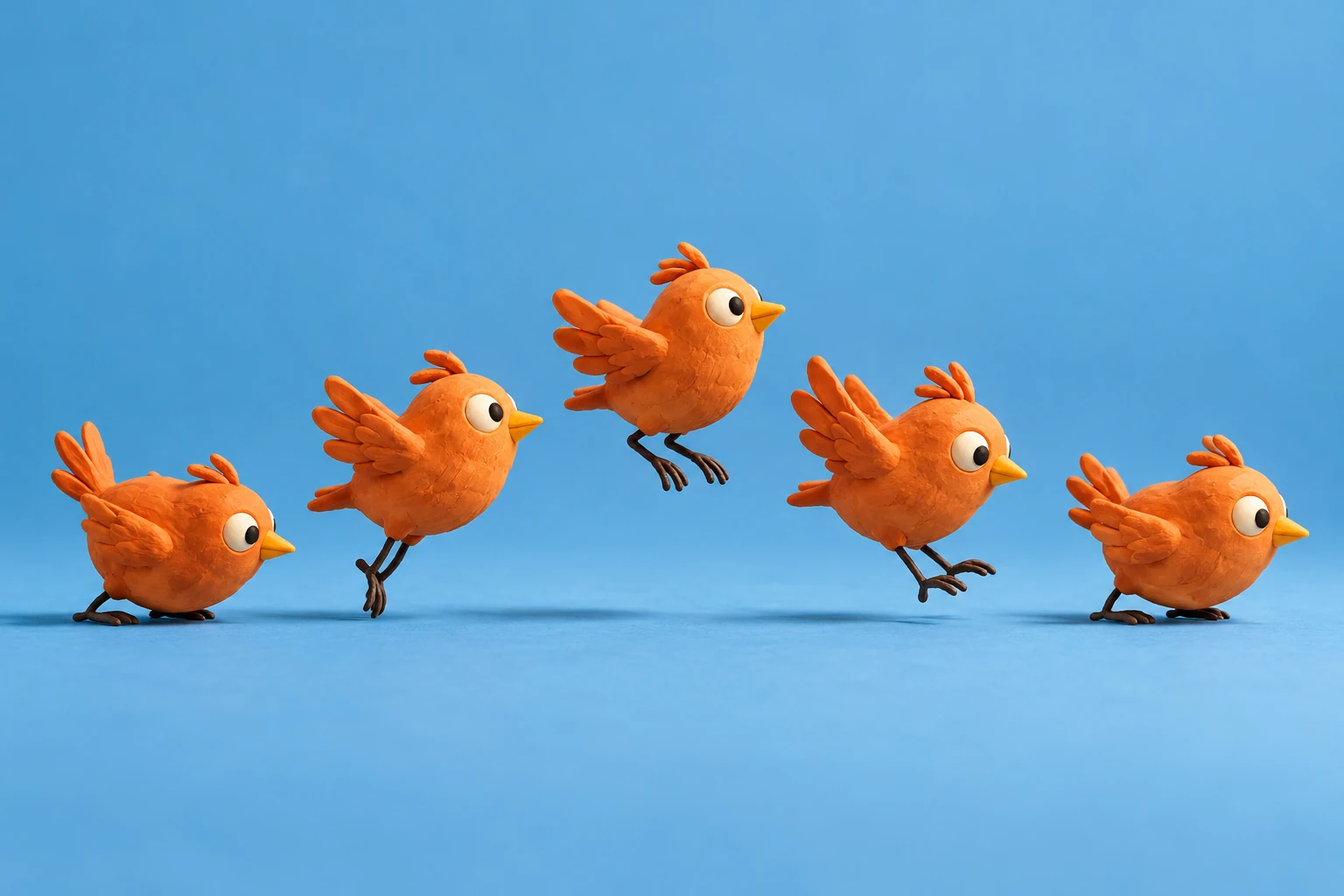
For the bird's bow, the head may need a second profile at the lowest pose to keep the beak readable. Cut that replacement before increasing the neck rotation beyond its useful range. Mark a shared alignment point on both heads so swapping them does not introduce a jump. Replacement shapes are part of the cutout vocabulary; a single rigid piece does not need to perform every possible silhouette.
A paper bird bowing
Build a long-necked paper bird that bows to pick up a tiny circle. Use a separate head and neck with overlapping shapes. Replace the beak with an open version at contact so a small shape change completes the action.
References & further reading
Examples and exercises in this guide are original teaching scenarios.