Make a paper mobile that balances and moves
Construct a lightweight hanging sculpture by balancing small assemblies, testing suspension points and movement clearance before building a larger system of connected parts.
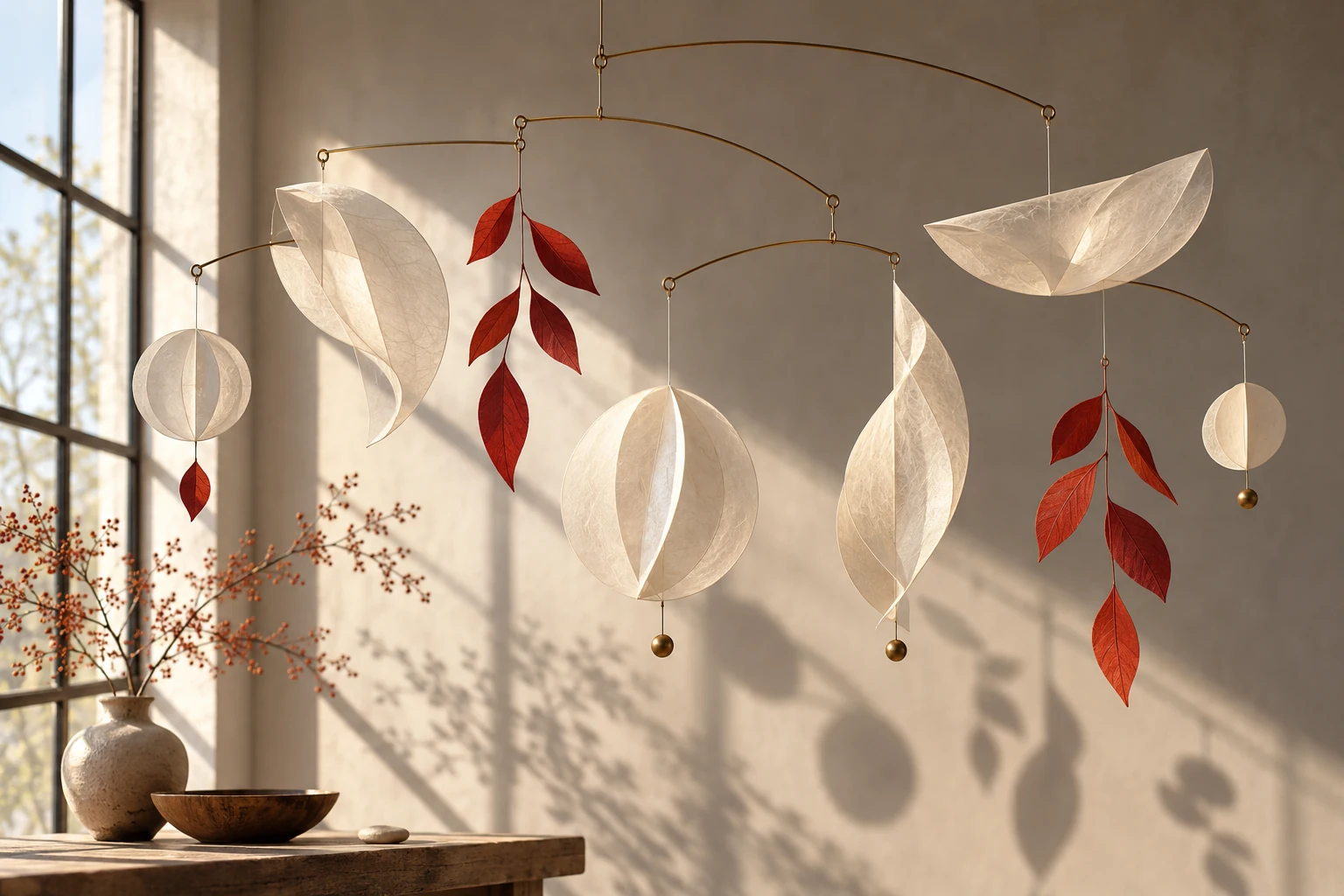
Balance creates a changing composition
A mobile is a sculpture organized around suspension and balance. Its parts can move in relation to one another, so the empty space between them matters as much as their shapes. Start with a tabletop-scale piece and lightweight materials that are easy to reposition.
Balance two shapes on a suspended bar
Hang two paper shapes from opposite ends of a stiff crossbar. Suspend the bar from a point between them and slide that point until the assembly balances as intended. Build a second small assembly separately, then hang it from a larger bar.
Write down the current setting for suspension-point position before making a second interpretation of the idea. Keep the first pass deliberately modest in scale. A manageable version is easier to inspect, undo, and reconstruct. Increasing complexity should answer a visible artistic need, rather than simply making the process look more elaborate. A useful acceptance check is whether the sculpture balances and its moving parts retain clear space. Judge that at the intended viewing size or working distance, where tiny construction mistakes and exaggerated effects can have very different consequences.
Check shifted threads and tangled clearances
If a bar tilts unexpectedly, check whether a hanging thread has shifted or a shape touches another part. If the mobile tangles, increase clearance between moving assemblies. Balance the structure again after every substantial change to a shape or attachment.
To locate a fault, inspect the part of the result most directly affected by suspension-point position. Inspect the undecorated structure with the moving or removable parts exposed. Try the intended action gently and watch where force or friction concentrates.
Balance unequal shapes at unequal distances
Compare a symmetrical mobile with one that balances unequal shapes at unequal distances. Watch both from several viewpoints. The second version can feel poised even when its visual arrangement is deliberately asymmetrical.
Arrange a small experiment with near the middle, slightly shifted, and close to the heavier side, keeping its other decisions consistent. Predict one consequence before each trial, then compare that prediction with the actual result. Record a surprise in plain language and identify the part of the construction that could explain it. This turns a set of variations into information you can use in a later, more ambitious piece.
Balance the lower assembly first
Suspend the three-drop subassembly alone and find its balance point before attaching it to the larger cloud bar. Once it behaves as one hanging unit, use its suspension point as the connection to the upper level. Add the cloud and adjust the upper balance. Do not try to correct an unstable lower assembly by shifting only the top suspension point. Each level needs enough clearance to turn without wrapping its threads around neighboring parts.
A cloud balanced against three drops
Make a rain-cloud mobile with one broad cloud and three narrow drops. Balance the cloud against a small hanging subassembly of drops rather than attaching everything to one bar. Keep the threads long enough for the parts to move without striking one another.
References & further reading
Examples and exercises in this guide are original teaching scenarios.