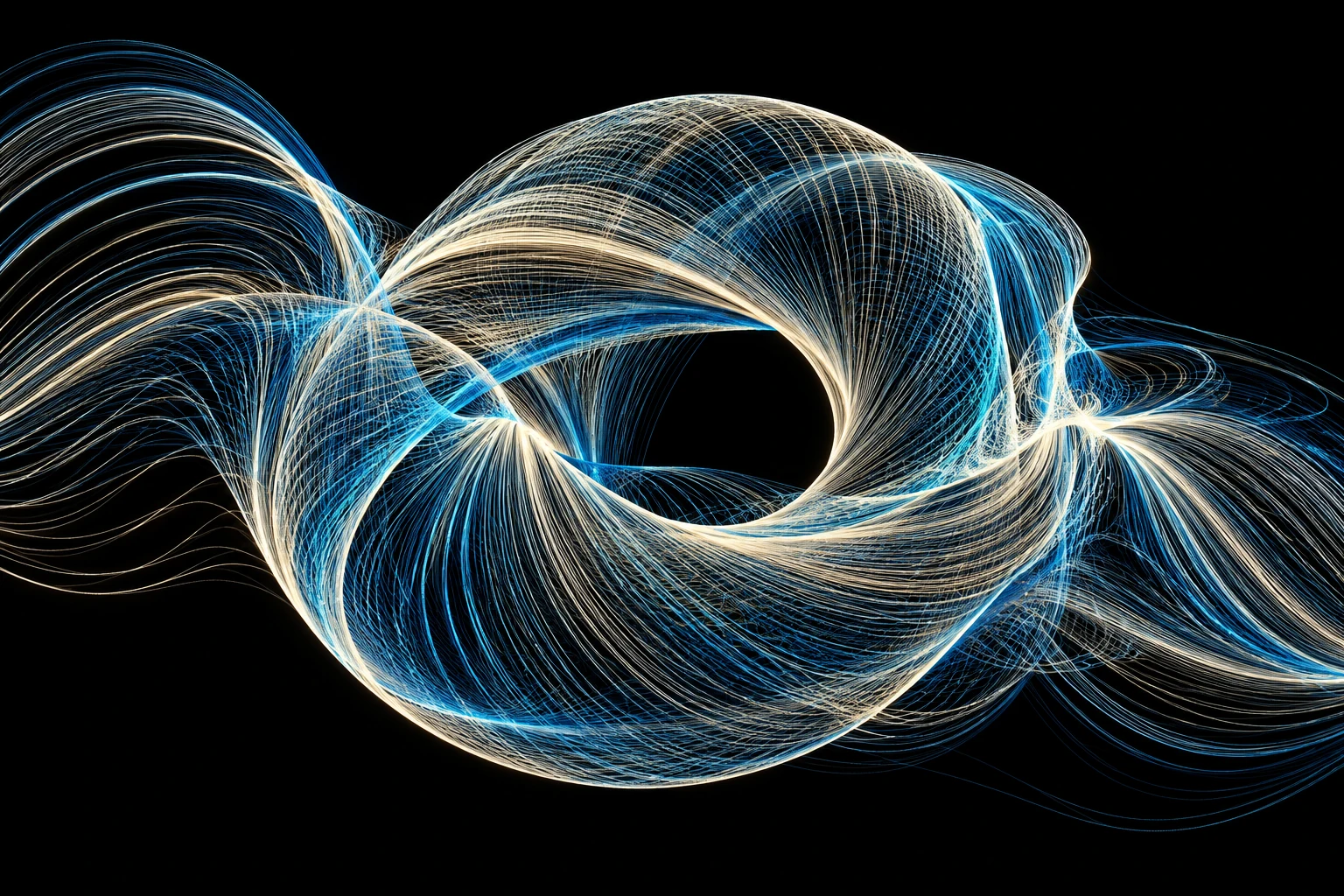
Lissajous art: draw with two rhythms
Use horizontal and vertical oscillations to create looping line art, then control closure, sampling, and phase without relying on random trial and error.

Two oscillations, one path
A Lissajous study combines two simple back-and-forth movements. One controls horizontal position and the other controls vertical position. When their rhythms relate cleanly, the path returns to familiar places and builds a recognizable loop. Phase changes where the two movements begin relative to each other.
Pair horizontal and vertical oscillations
Calculate x from a sine of one frequency times a parameter, and y from another. Add the canvas center after scaling each result. Sample the parameter over a known interval and join neighboring points. Start with small whole-number frequencies so the structure is easy to follow.
Separate phase offset from the other decisions so that a later revision has an identifiable cause. Break the construction into a single working unit and a repeated or extended form. Verify the unit on its own first. Only multiply it after its boundaries, movement, and proportions match the proposed rule. A useful acceptance check is whether the path closes intentionally and its loops stay easy to follow. Judge that at the intended viewing size or working distance, where tiny construction mistakes and exaggerated effects can have very different consequences.
Inspect the closing segment
A diagonal slash through the image may be a final connection between endpoints that do not actually meet. Compare the first and last coordinates before closing the shape. Large sampling steps create corners; very small steps add work without necessarily changing the result.
Treat a disappointing result as evidence about phase offset, rather than immediately adding another effect. Temporarily show construction points and intermediate values. Reduce repeated elements to a handful and pause anything that changes over time.
Vary phase before changing frequency
Keep frequencies at two and three while changing only the phase offset. Place the results beside one another. Then change one frequency to four and observe how the number and arrangement of lobes changes.
Use 0, one eighth, and one quarter of a turn as three deliberately separated trial conditions. Keep the subject, framing, and main materials consistent across those trials. Note what changes first, what remains stable, and where the intended effect becomes excessive. Choose a version for an articulated reason. A useful note names a visible relationship that you could inspect again, rather than simply calling the result better.
Use a known closure interval
For horizontal frequency two and vertical frequency three, sample a complete shared base turn with consistent angle units. Compare the last computed point with the first before closing the path. If you later use a noninteger frequency ratio, the same interval may no longer close. An open ending can be intentional, but the final join should not be drawn merely because the earlier integer-frequency study used a closed outline.
A three-curve ribbon
Draw a narrow ribbon by plotting three neighboring curves with slightly different phase offsets. Leave them unfilled and avoid joining their ends across curves. This produces a small family of related trajectories rather than a single thick line masquerading as a ribbon.
References & further reading
Examples and exercises in this guide are original teaching scenarios.